
Three apps, three jobs on appointment day. But before the kit matters, the embassy appointment booking itself has to land at the right office, and that booking sits on top of a global map most travelers never see. We counted the offices in our database to show the shape of the network your appointment day belongs to.
The map behind the booking
The database holds 1,397 consular office records spread across 119 host countries. The United States hosts the most recorded offices with 150, followed by China with 88, Germany with 59, India with 51 and Japan with 46. In other words, a consular network is not a handful of capital-city embassies; it is hundreds of offices in dozens of countries, and your booking can sit anywhere in it.
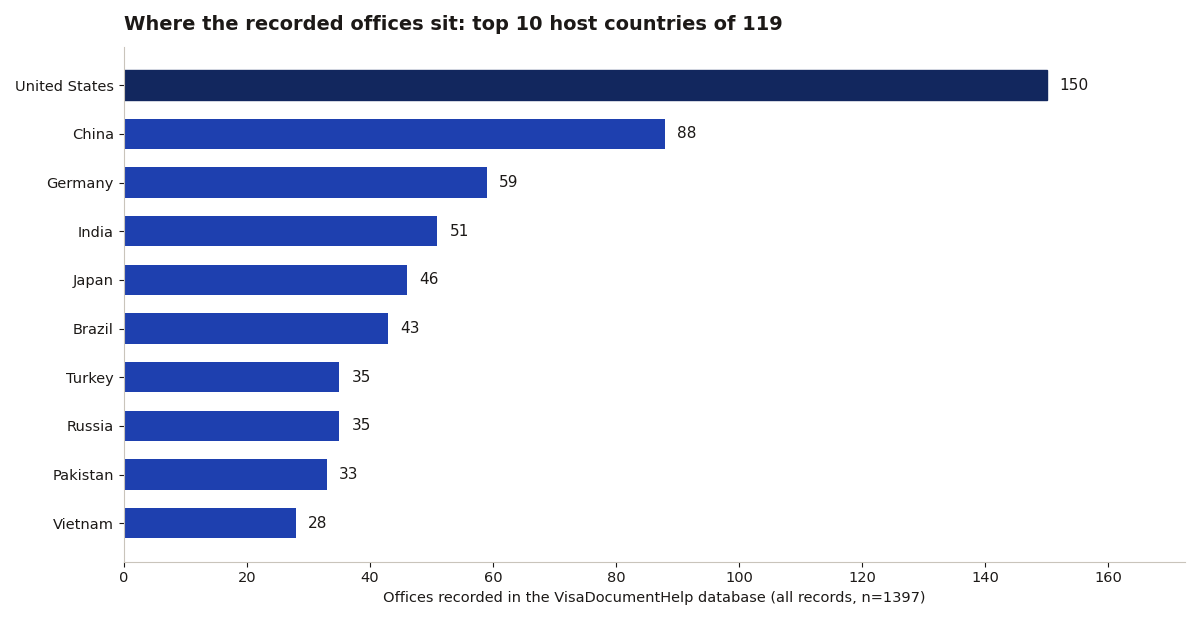
That spread is why the kit has to travel well. The signs at your application center may be in a language you do not read, the officer's questions will reference an itinerary you need at your fingertips, and the trip home runs through an entry process of its own. Three different problems, three different apps, no overlap.
The sending side of the map matters too. Just 22 countries run the 1,397 recorded offices: China sends 186, the United States 172, Russia 166, France 124 and the United Kingdom 111. The language your paperwork arrives in follows the sending country, not the host city, so the offline language pack worth downloading is the sending country's, whether the office is in Houston or Hanoi. The five biggest host countries hold 394 of the 1,397 recorded offices between them, which means a kit tuned for the big networks covers most trips, and the long tail of smaller posts is where the offline preparation earns its keep.
The kit itself
Google Translate handles the language barrier. Camera mode reads foreign-language signs and forms at the application center. Download the offline pack beforehand; the building's Wi-Fi will not save you. TripIt keeps the trip's facts straight. When the officer asks for your itinerary, the consolidated timeline with flights and hotels answers in seconds. It does not book appointments or check requirements. Mobile Passport Control speeds up US entry after you land. It is irrelevant to getting the visa and essential after you have it. Do not confuse the two phases.
Pack for the office you actually got
For US applicants the appointment is often a trip in itself: the 150 recorded US offices sit in 56 cities, so plenty of people fly or drive hours to reach the office their jurisdiction assigns. That is where the kit stops being a phone habit and becomes the travel plan. TripIt holds the consulate trip and the main trip in one timeline, so a changed flight does not quietly desync the appointment. Translate's offline pack matters most exactly where the network is thinnest, at the smaller posts where signage and forms are least likely to offer English. And the document folder, scans of everything you filed, kept on the phone rather than in the cloud, is the backup when a center asks for a paper you were sure you had already given them.
Set the kit up the night before, not in the queue. Download the language pack on home Wi-Fi, export the itinerary where it works offline, and finish the Mobile Passport Control profile before the return flight, not during it. None of this books the appointment for you. All of it decides whether the booking you already made turns into a visa or into a story.
Booking is step one, not the whole trip
Two free checks on this site close the gaps the kit cannot. The consulate database search confirms the office you booked is the one assigned to your state or region, and Honorary or Real? confirms that office type can actually do the job you are traveling for. Run both when you book, not in the taxi on the way there.
The kit works because nothing overlaps. Translate decodes, TripIt organizes, MPC expedites. Add your slot alert and your document folder, and consulate day becomes admin instead of adventure.
Sources: U.S. State Department